How to Choose School Classroom Furniture for Pre-Primary, Primary and Secondary Grades
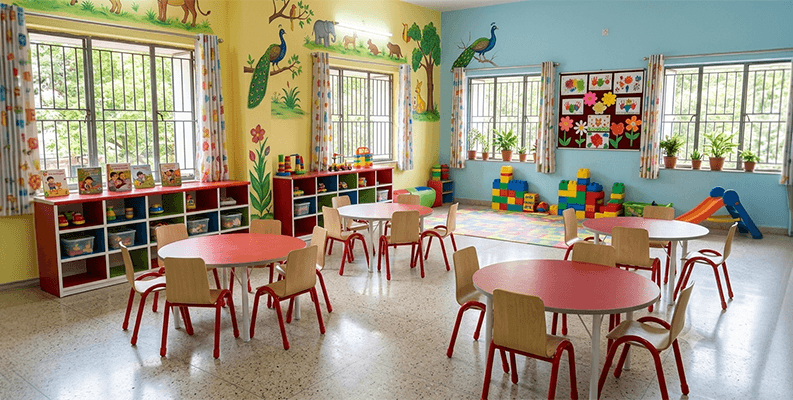
Choosing the right school classroom furniture directly impacts student posture, classroom focus, safety and long-term maintenance budgets. Because a four-year-old in nursery and a fifteen-year-old in Grade 10 differ vastly in height and learning style, a one-size-fits-all seating approach causes physical strain and restricts movement. This classroom furniture selection guide outlines how school leaders and architects can select age-appropriate school furniture across every grade.
Understanding Classroom Furniture for Different Age Groups
Pre-Primary Classroom Furniture (Nursery, LKG and UKG)
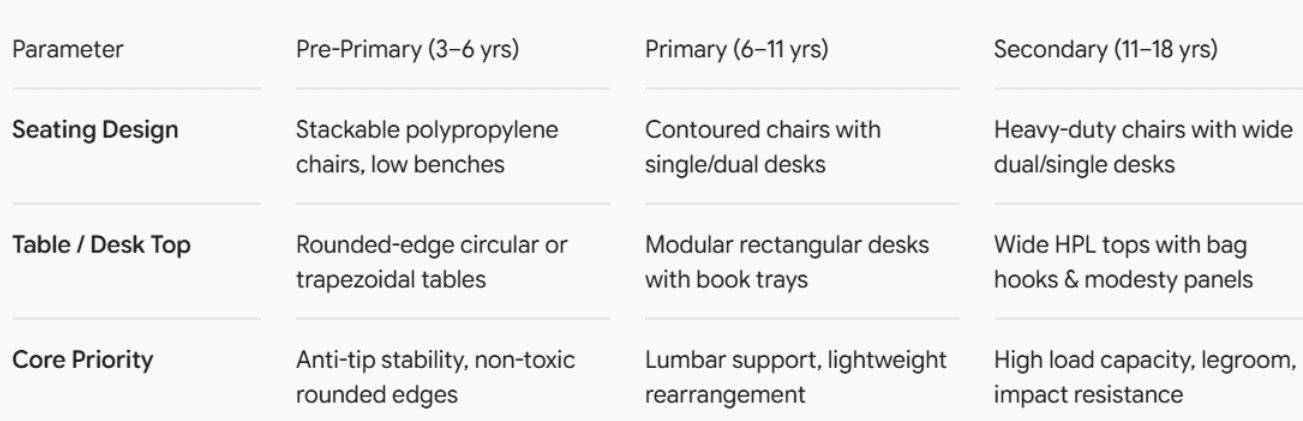
What furniture is suitable for pre-primary classrooms? Pre-primary rooms require lightweight, low-height tables and chairs with rounded bullnose edges, non-toxic finishes and open cubby storage so children aged 3 to 6 can sit safely and move independently. Circular or trapezoidal activity tables support play-based group learning while eliminating sharp corner hazards.
Primary School Classroom Furniture (Grades 1–5)
When deciding how to select furniture for primary and secondary classrooms, start with developmental needs. For ages 6 to 11, primary school classroom furniture should feature contoured lumbar backrests, waterfall seat edges and under-desk book boxes. Modular single or dual desks allow teachers to switch quickly between lecture rows and collaborative pods in line with NEP 2020 activity-based pedagogy.
Secondary School Classroom Furniture (Grades 6–12)
Secondary school classroom furniture for students aged 11 to 18 demands higher structural load capacity and wider desktops for textbooks and laptops. Powder-coated mild steel (CRCA) tubular frames paired with scratch-resistant High-Pressure Laminate (HPL) tops withstand heavy daily wear, alongside specialised workbenches for science and computer labs.
How to Choose the Right School Desk and Chair Sizes by Age
What is the ideal desk and chair height for students? The ideal height allows a student to sit with feet flat on the floor, knees bent at 90 degrees and elbows resting comfortably on the desktop without hunching. In India, Bureau of Indian Standards (BIS) IS 4837 specifies dimensional size codes across student height ranges.
Key Factors & Mistakes to Avoid in Classroom Furniture Selection
When evaluating ergonomic school furniture, principals and procurement teams should prioritise eight essentials: student growth alignment, lumbar support, steel gauge and laminate quality, pinch-free safety, CAD aisle clearances, easy floor cleaning, modular flexibility and total lifecycle cost.
Avoid common purchasing pitfalls such as buying one desk size across multiple grades, overpacking classrooms without checking door and walkway clearances, accepting low-grade PVC edge-banding that peels early, or skipping physical sample testing before placing orders.