What Should a School Check Before Buying Furniture in Bulk?
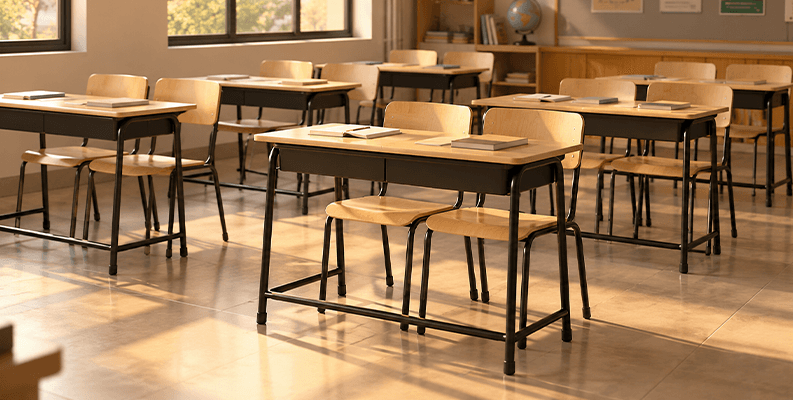
Buying furniture in bulk for a school, college, or educational institution is a major capital investment. Outfitting an entire campus, from K-12 classrooms and science labs to auditoriums, canteens, and libraries, requires long-term planning, structural evaluation, and careful budget management.
Making the wrong procurement decision can result in recurring repair costs, poor ergonomic posture for students, and safety hazards. To help institutional buyers and school administrators make informed choices, this comprehensive school furniture buying guide breaks down essential factors to review before placing a bulk order.
The Ultimate School Furniture Supplier Checklist
When evaluating bulk school furniture suppliers, use this structured decision framework before signing purchase orders:
1. Ergonomic Compliance & Age-Appropriate Sizing
Students spend up to six hours a day sitting at classroom desks. Static, poorly proportioned seating causes fatigue, poor posture, and lack of focus.
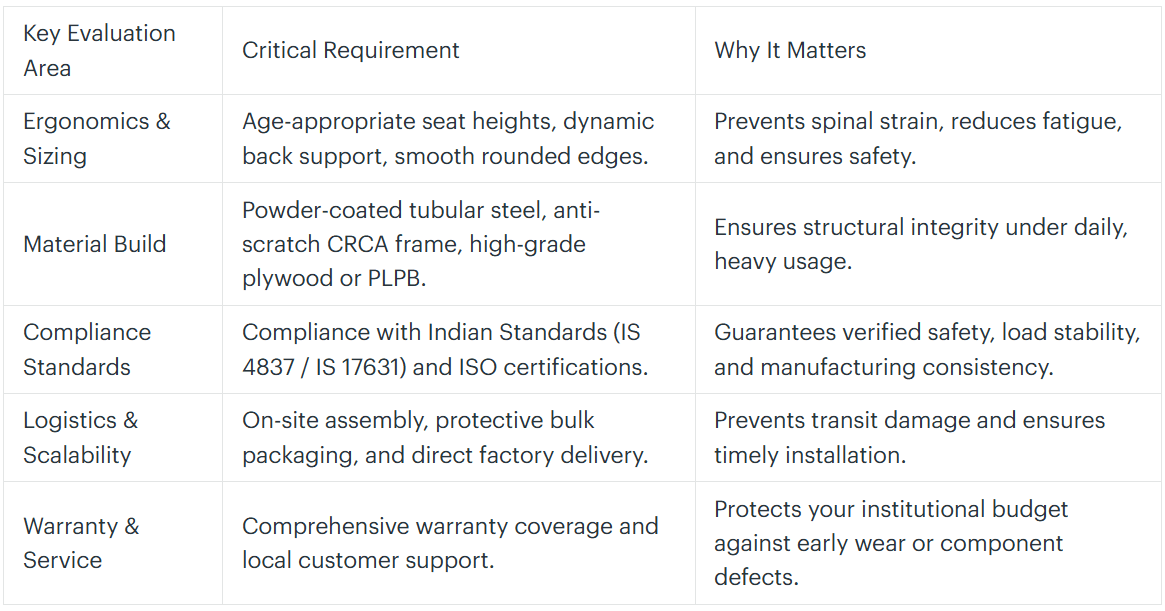
- Anthropometric Sizing: Primary school children require lower seat heights (typically 260 mm to 340 mm), while senior secondary students require standard heights (380 mm to 420 mm) as outlined in Indian Standard IS 4837.
- Safety Features: Check that desk corners and chair seats feature rounded PVC edge banding or soft edges to eliminate sharp points and prevent injuries.
- Versatility: Consider height-adjustable single or dual desks to accommodate varying student growth cycles across different grades.
2. Structural Strength and Material Quality Standards
Educational environments demand durable school furniture built to handle rough daily wear, frequent movement, and high impact.
When inspecting samples from a school furniture wholesale provider, evaluate:
- Frame Architecture: High-gauge Cold Rolled Close Annealed (CRCA) steel tube framing with anti-rust epoxy powder coating provides structural rigidity and corrosion resistance.
- Table Tops & Panels: Look for high-pressure laminate (HPL) tops, pre-laminated particle boards (PLPB), or solid marine-grade plywood that resist scratches, moisture, and chemical spills.
- Joints and Welds: Robotic or full-bead MIG welding ensures strong, seamless joints that will not loosen under heavy load capacities.
3. Total School Furniture Cost vs. Long-Term Value
Evaluating school furniture cost involves analyzing the total cost of ownership over a 5 to 10-year period, rather than focusing solely on the initial quote.
Total Procurement Cost = Initial Unit Cost + Shipping & Delivery + Assembly Fees - Long-Term Maintenance Savings
Avoid Ultra-Low-Cost Offerings: Low initial prices often indicate thinner sheet metal, untreated wood prone to termite attack, or poor powder coating that chips quickly.
Bulk Volume Pricing: Verify whether tiered discounts apply for larger orders across multiple campus blocks.
Replacement Parts: Ensure the supplier maintains stock for individual components, such as desk glides, seat shells, and modesty panels, so entire units do not need replacement over minor damage.
4. Selecting the Right Bulk School Desk and Chair Suppliers
Finding trusted bulk school desk and chair suppliers requires verifying their manufacturing infrastructure and delivery capabilities.
Factory Direct vs. Middlemen
Sourcing directly from an established school furniture manufacturer in India eliminates broker markups, provides custom color options, and guarantees consistent quality control across large orders.
Sample Inspection & Testing
Before issuing a bulk purchase order, request full-scale physical samples. Test the units for load stability, joint rigidity, anti-tipping balance, and ease of cleaning.